

Beyond Tradition: How AI Precision Elevates Montessori Wooden Toys
In the world of early childhood education, Maria Montessori taught us to follow the child. She emphasized natural materials, sensory experiences, and tools that respect a child’s developmental stage.
At YUCI, we are often asked a challenging question: "How does Artificial Intelligence fit into a philosophy grounded in nature?"
The answer lies not in replacing nature, but in understanding it better. We don't use AI to put screens in toys. We use AI to create the perfect wooden form for your child’s hands.
Here is how we define AI-Native Montessori Design.
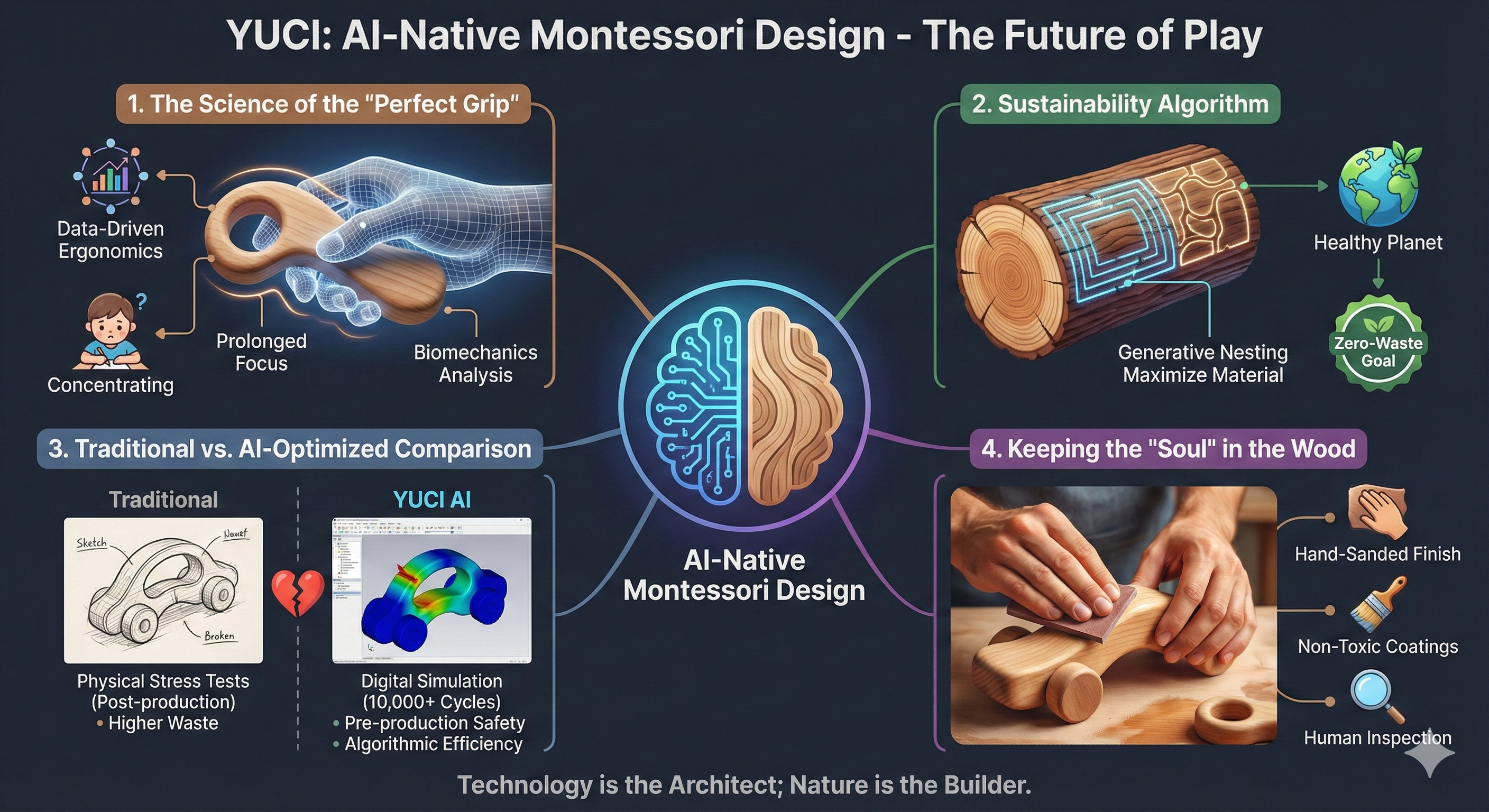
1. The Science of the "Perfect Grip"
Traditional wooden toys are often designed based on historical templates. While classic, they don't always account for the subtle biomechanics of a toddler's grasp.
At YUCI, we utilize AI modeling to analyze thousands of data points regarding children's hand sizes and grip strengths at different ages. This allows us to generate:
-
Ergonomic Curvature: Handles and shapes that reduce strain and encourage prolonged, focused play (Deep Work).
-
Weight Distribution: Ensuring the center of gravity supports the child's movement, whether they are stacking, pulling, or fitting objects.
2. Innovation Without Waste: The Sustainability Algorithm
Montessori education teaches respect for the environment. AI is our most powerful tool for sustainability.
When carving toys from premium natural wood, traditional methods can result in significant scrap. Our design algorithms utilize generative nesting strategies. This means the AI calculates the most efficient way to cut each shape from a raw log, maximizing the use of every tree.
Impact: We reduce wood waste significantly, ensuring that your purchase supports a greener planet without compromising on quality.
3. Comparison: Traditional vs. AI-Optimized Design
Why does data-driven design matter for your child?
| Feature | Traditional Wooden Toys | YUCI AI-Optimized Toys YUCI |
| Design Origin | Historical templates & manual sketches |
Data-driven ergonomics & generative morphology |
| Safety Testing | Physical stress tests (Post-production) | Digital simulation of 10,000+ stress cycles (Pre-production) |
| Material Usage | Standard cutting (Higher waste) |
Algorithmic nesting (Zero-waste goal) |
| Aesthetics | Classic, geometric shapes |
Organic, fluid forms inspired by nature |
| Philosophy | Passive Play | Active, Scientifically-Calibrated Play |

4. Keeping the "Soul" in the Wood
While AI designs the concept, it cannot replace the warmth of touch. Once our AI generates the blueprint, the baton is passed to our master craftsmen.
Every YUCI toy follows a strict finishing process:
-
Hand-sanded to a velvet finish.
-
Coated with non-toxic, water-based paints.
-
Inspected by human eyes for that unique grain pattern.
Technology is the architect; nature is the builder.
Frequently Asked Questions
Q: Are AI-designed toys safe for babies?
A: Yes. In fact, they can be safer. AI allows us to simulate "break points" and structural integrity risks that a human designer might miss. We fix these potential issues digitally before a single piece of wood is cut.
Q: Does YUCI use robots to make the toys?
A: No. We use AI for the ideation and engineering phase. The manufacturing process involves traditional woodworking techniques to ensure the sensory warmth that Montessori advocates.
Q: What is the benefit of AI in sensory toys?
A: AI helps us map "sensory complexity." We can calculate exactly how much visual or tactile texture is stimulating versus overwhelming, creating the ideal balance for a child's concentration.



